
Milk Is an Example of What Type of Matter?
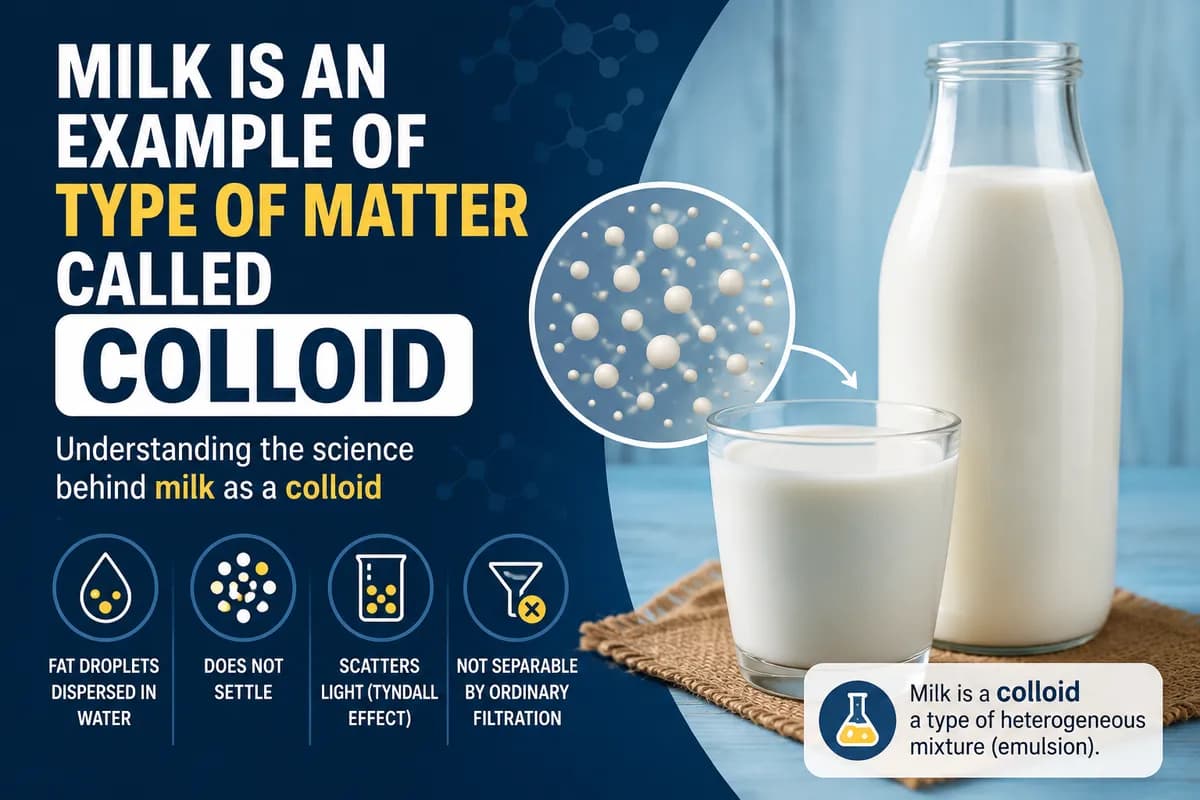
Milk is an example of a colloid, which is a special type of mixture. It may look like a simple liquid, but scientifically, milk is made up of tiny particles of fat, proteins, vitamins, minerals, and water that are mixed together. Because these particles do not completely dissolve, milk is classified as a colloidal mixture rather than a pure substance.
In this article, we'll explore why milk is considered a colloid, how it differs from other types of matter, and why this classification is important in science.
What Is Matter?
Matter is anything that has mass and occupies space. Everything around us—including air, water, rocks, plants, and milk—is made of matter.
Matter is generally divided into two main categories:
- Pure substances – Elements and compounds with a fixed composition.
- Mixtures – Combinations of two or more substances that are physically combined.
Since milk contains several different substances mixed together, it belongs to the mixture category.
What Type of Mixture Is Milk?
Milk is a colloid, specifically an emulsion.
A colloid is a mixture in which very small particles of one substance are evenly dispersed throughout another substance. These particles are too small to settle at the bottom and cannot be easily separated by ordinary filtration.
In milk:
- Water acts as the continuous medium.
- Fat droplets are dispersed throughout the water.
- Proteins, lactose, vitamins, and minerals are also present.
This stable distribution of tiny fat droplets is what gives milk its smooth appearance and creamy texture.
Why Is Milk Not a Solution?
A solution is a homogeneous mixture where the particles dissolve completely and cannot be seen, even under a microscope.
Milk is not a true solution because:
- Fat droplets remain suspended rather than dissolving.
- The particles are larger than those found in a solution.
- Milk scatters light, a property known as the Tyndall effect, which is characteristic of colloids.
Characteristics of Milk as a Colloid
Milk has several properties that make it a perfect example of a colloid:
- Tiny fat droplets remain suspended in water.
- The particles do not settle under normal conditions.
- It appears uniform to the naked eye.
- It scatters light because of the suspended particles.
- It cannot be separated by simple filtration.
Types of Matter Comparison
|
Type of Matter |
Description |
Example |
|---|---|---|
|
Pure Substance |
Made of one type of particle |
Distilled water, gold |
|
Solution |
Particles dissolve completely |
Salt water, sugar water |
|
Colloid |
Tiny particles remain suspended |
Milk, fog, mayonnaise |
|
Suspension |
Larger particles settle over time |
Muddy water |
Is Milk Homogeneous or Heterogeneous?
Milk appears homogeneous because it looks uniform throughout. However, from a scientific perspective, it is considered a heterogeneous mixture because it contains different substances that are not chemically combined.
The particles are simply too small to be seen without special instruments.
Everyday Examples of Colloids
Milk is not the only colloid you encounter every day. Other common examples include:
- Butter
- Mayonnaise
- Whipped cream
- Fog
- Smoke
- Jelly
- Toothpaste
- Shaving cream
Each of these contains tiny particles dispersed throughout another substance.
Frequently Asked Questions
What type of matter is milk?
Milk is a colloid, which is a type of heterogeneous mixture.
Is milk a pure substance?
No. Milk contains water, fats, proteins, sugars, vitamins, and minerals mixed together, making it a mixture rather than a pure substance.
Why is milk called an emulsion?
Milk is called an emulsion because tiny droplets of fat are dispersed throughout water.
Is milk a solution or a suspension?
Milk is neither a true solution nor a suspension. It is a colloid, which has properties between the two.
Conclusion
Milk is an example of a colloid, specifically an emulsion, making it a special type of heterogeneous mixture. Although it appears uniform, it contains tiny fat droplets and proteins dispersed throughout water. These particles remain suspended without settling, giving milk its characteristic creamy appearance and making it one of the most common examples used to explain colloids in chemistry.
Whether you're studying science for school or simply curious about everyday materials, understanding why milk is classified as a colloid is a great way to learn how different types of matter behave.