
How Buzinessify's Commercify Helps Online Stores Grow Beyond a Patchwork of E-Commerce Tools

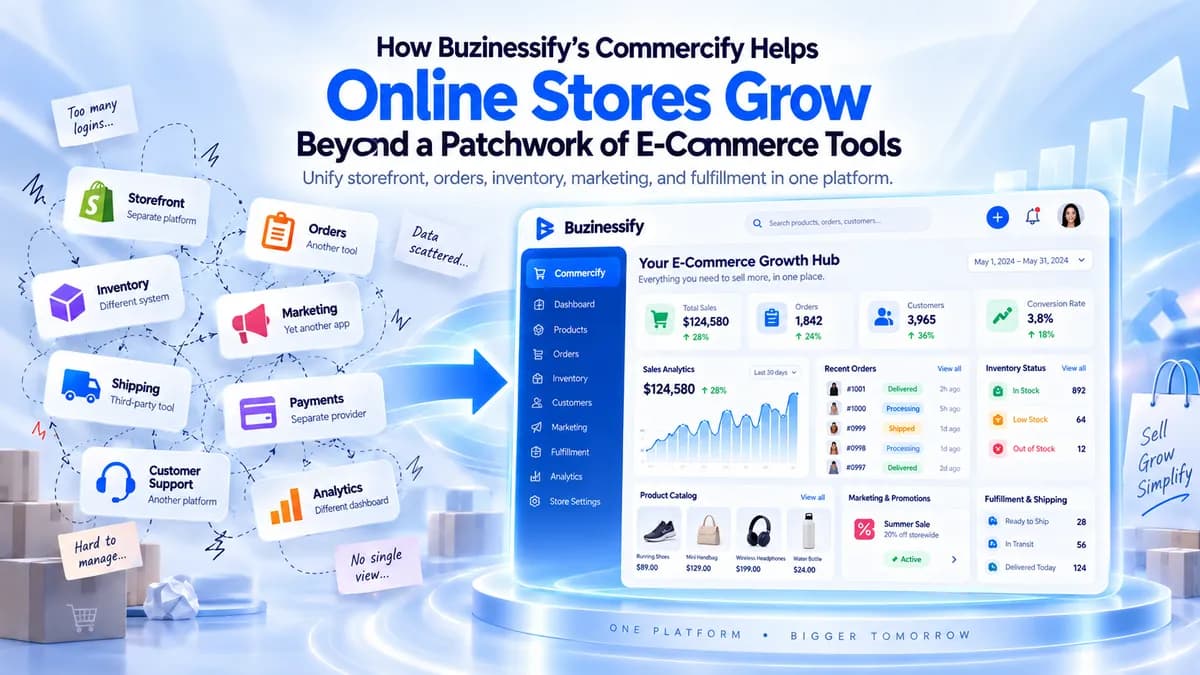
Most online stores don't choose their tool stack. They accumulate it, one urgent problem at a time.
A new online store usually starts simple: a storefront platform, a way to list products, a way to take payment. Then it grows. Orders pile up faster than a spreadsheet can track them. Customer questions need a proper support inbox instead of a shared email. Inventory across a few sales channels needs to stay in sync, or a product sells out on one channel while still showing as available on another.
Each addition solves a real problem at the time. What it also does, quietly, is add one more system that the rest of the stack has to be manually kept in agreement with.
Where Online Stores Actually Feel the Friction
Catalog data that lives in more than one place
Product details get entered into the storefront platform, then again into a separate inventory tool, then again into whatever powers a secondary sales channel. A price change or a new variant means updating the same information three times.
Orders that need cross-referencing to explain
A customer asks about their order status, and answering means checking the storefront for the order, a shipping tool for fulfillment status, and possibly a separate finance tool to confirm payment actually went through.
Customer support that's disconnected from the order itself
A support question comes in with no direct link to the customer's order history, so the person answering it has to go hunting for context before they can actually help.
None of this is a sign of a poorly run store. It's what naturally happens when catalog, orders, and support tools are chosen separately, at different points in a store's growth, with no single system responsible for keeping them in sync.
How Commercify Approaches This Differently
Commercify is built as an e-commerce business management platform, unifying a store's catalog, orders, and customer experience in one system, rather than treating them as separately purchased tools that happen to sit next to each other.
One catalog, not three
Product listings, pricing, and inventory levels live in one place, so a change made once is the change that's actually live everywhere it needs to be, instead of a manual update repeated across systems.
Orders with full context attached
Order status, payment, and fulfillment sit together, and support conversations connect to that same order record through Inboxify, so answering a customer's question doesn't require checking three separate systems first.
Finance that doesn't need reconciling by hand
Revenue and order data flow into Ledgerify directly from the same orders a store is already processing, rather than requiring a separate export-and-match process at the end of each month.
A Practical Example
Picture a boutique store fulfilling a customer order.
● A customer places an order, and inventory updates immediately across the store's catalog.
● A question comes in about shipping, and the support conversation is already linked to that exact order — no separate lookup required.
● The order's revenue reflects in the store's financial records without a manual export.
None of these steps individually looks dramatic. Together, they remove the specific busywork that comes from three systems each holding a different piece of the same sale.
Who This Is For
This applies whether a store is managing a small, curated catalog or thousands of SKUs — the specific friction just tends to compound faster the more products and orders move through the system. It matters most for stores that have outgrown a single storefront tool but haven't yet built out a dedicated ops team to manually keep several separate systems in sync.
For stores running regular promotions or campaigns, Emailify connects to the same customer and order data, so campaigns can be built around actual purchase history instead of a separately exported contact list.
A Realistic Expectation
Commercify won't replace the work of actually running a good store — sourcing the right products, pricing them well, and building a brand customers trust are decisions no platform makes for a business. It removes the operational friction around catalog, orders, and support, not the strategy behind them.
Migrating an existing catalog and order history into a new system also takes real setup time, and a very small store with a handful of orders a month may not feel much of this friction yet. The value grows as order volume and catalog size grow past what a spreadsheet and a shared inbox can reasonably handle.
The Bottom Line
Most of the operational drag in a growing online store isn't one big problem — it's a handful of small mismatches between systems that were never meant to agree with each other: a catalog updated in one place but not another, an order that takes three lookups to explain.
Commercify exists to close that specific gap, keeping a store's catalog, orders, and customer experience working from the same information.
Book a Demo or Get Started with Buzinessify to see how Commercify brings your store's catalog, orders, and customer support into one platform.